
 By Oscar Woods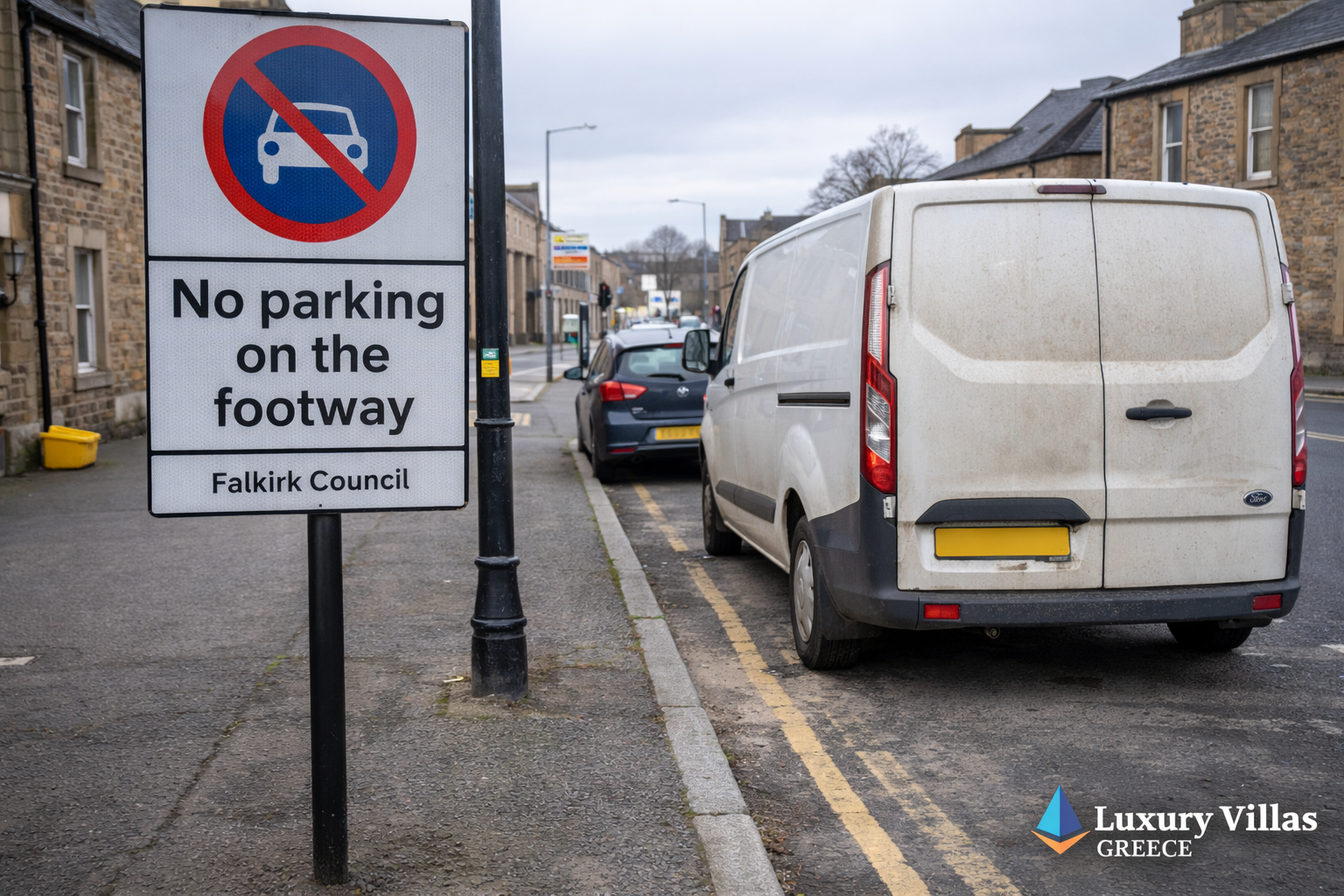
Falkirk Council began enforcing its pavement parking ban on August 18, 2025, marking a major shift in how drivers can park across the region. The new regulations carry a £100 penalty for violations, reduced to £50 if paid within two weeks.
The ban stems from Scottish Government legislation passed in 2019 and updated in 2023, giving local authorities across Scotland the power to fine drivers who park illegally on pavements. Falkirk Council followed 16 other Scottish authorities in implementing the rules, ending a year-long awareness campaign that saw 1,800 advisory notices issued to drivers.
Table of Contents
What the Ban Covers
The new rules prohibit four specific parking behaviors across Falkirk:
- Parking on pavements with even one wheel on the footway
- Parking on low verges next to roads
- Blocking dropped kerbs used by wheelchair users and pedestrians
- Double parking on carriageways
Council Leader Cecil Meiklejohn said pavements are vital pathways for pedestrians, especially those with mobility challenges and visual impairments. She stressed that motorists must park considerately to ensure safe access for everyone.
Why Falkirk Introduced the Ban
The legislation aims to protect vulnerable road users who face daily obstacles from inconsiderate parking. People using wheelchairs, those with visual impairments, and parents pushing prams often find themselves forced onto roads when vehicles block pavements.
Allan McBride, a Falkirk resident who is severely sight impaired, shared his experience living on Shore Road in Airth. He explained that parked cars on pavements disrupt his carefully planned routes and force him to step onto the road, creating dangerous situations.
McBride noted that vehicles sometimes park partially or fully on the pavement outside his home, making navigation difficult. He often plans routes in advance to navigate public spaces safely, but pavement parking throws those plans into chaos.
For people with sight loss, pavements provide structured, predictable routes. When vehicles obstruct these pathways, it blocks tactile cues like textured paving and kerb edges that help with safe navigation.
Assessment and Exemptions
Over the past year, council officers assessed all 2,360 roads across the Falkirk area. Out of these, 21 streets are being considered for exemptions or mitigation measures.
More than 85 percent of roads showed little pavement parking, but 348 roads were classified as having significant issues, with more than a quarter of their length used for pavement parking.
Streets narrower than 7.6 meters, where moving parked cars would create problems in neighboring areas, received further consideration. The council will review these locations on a case by case basis.
Areas granted exemptions will have clear signage indicating where pavement parking is permitted. Until these considerations are complete, enforcement will not apply to these 21 streets.
Vehicles Exempt from Fines
Certain vehicles can park on pavements under specific circumstances:
Emergency services including police, ambulance, fire, and coastguard vehicles responding to incidents
Utility and road works vehicles carrying out maintenance or removing traffic obstructions
Medical practitioners including registered nurses and midwives providing urgent or emergency care
Delivery vehicles loading or unloading goods for business purposes, limited to 20 minutes
Recovery vehicles assisting at accidents or breakdowns
These exemptions only apply when parking cannot reasonably be carried out on the carriageway, and vehicles must maintain at least 1.5 meters of clear pavement width between the vehicle and the far edge of the footway.
Enhanced Enforcement Team
Falkirk Council appointed additional enforcement officers to implement the ban effectively. The team now includes eight traffic wardens, with new positions allowing for back shift coverage.
Most pavement parking occurs during evenings at the end of the traditional working day, so the extended hours will help address peak violation times.
Engineering design manager Gary McGregor told councillors that the team has already seen behavior changes from drivers who received advisory notices. The council expects this trend to continue now that financial penalties are in effect.
National Context
Scotland became the first of the four UK nations to ban pavement parking nationwide. The Transport Scotland Act 2019 established the framework, with enforcement powers granted to local authorities from December 11, 2023.
Transport Minister Fiona Hyslop launched a national awareness campaign highlighting the dangers pavement parking poses to users. The campaign included radio, outdoor, and social media advertising to ensure all Scottish residents understood the incoming changes.
Edinburgh Council was the first authority to implement enforcement in January 2024. Since then, councils across Scotland have progressively rolled out the ban in their areas.
Impact on Residents
The ban represents a significant change for drivers accustomed to parking on pavements, particularly in residential areas with limited road width. Some residents have expressed concerns about where to park their vehicles, especially in older neighborhoods not designed for modern car ownership levels.
However, disability organizations and active travel groups have praised the legislation. Walk Wheel Cycle Trust Scotland Director Karen McGregor called it a long overdue victory for equality, noting that pavement parking locks vulnerable people out of public spaces.
Workshop participants in a disabled citizen inquiry revealed the serious impact of pavement obstacles. One guide dog user described having to orientate herself and start over when encountering parked cars, sometimes choosing to return home rather than risk stepping onto busy roads.
What Drivers Need to Know
Drivers should ensure all four wheels remain on the carriageway when parking. Even having one wheel on the pavement counts as a violation and can result in a penalty charge notice.
If a parking attendant observes a driver sitting behind the steering wheel while parked on a pavement, they will ask the driver to move before issuing a fine.
The Falkirk Council pavement parking ban applies to all streets regardless of design, length, or purpose. Private roads within the area also fall under the regulations.
Disabled badge holders are not exempt from the ban. The legislation applies equally to all drivers except those specifically listed as exempt while carrying out their duties.
Council officials encourage anyone uncertain about parking rules to visit the Falkirk Council website, where detailed FAQs and information about exempt areas are regularly updated. Drivers can also contact the council directly with questions about specific streets or circumstances.
The enforcement measures aim to create safer, more accessible communities where all residents can move around with confidence and dignity.