
 By Oscar Woods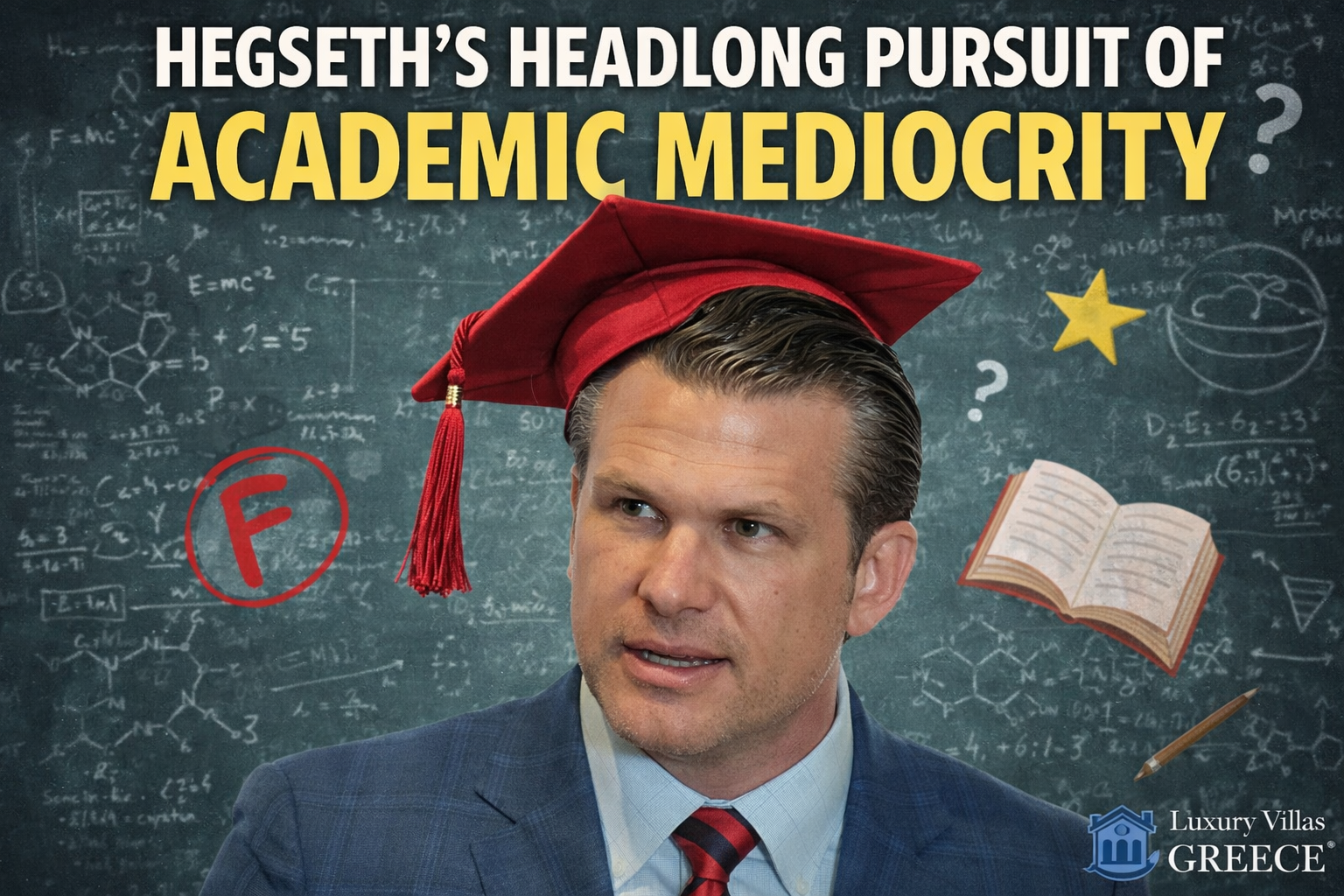
The phrase “Hegseth’s headlong pursuit of academic mediocrity” has emerged as a sharp criticism of Defense Secretary Pete Hegseth’s sweeping changes to military education. Despite holding degrees from Princeton and Harvard, the former Fox News host is now dismantling the very academic traditions that shaped generations of military leaders.
Table of Contents
From Elite Universities to Education Opponent
Hegseth graduated from Princeton University in 2003 with a degree in politics and later earned a Master of Public Policy from Harvard’s Kennedy School in 2013. He left the Army National Guard at the rank of major after serving deployments in Iraq, Afghanistan, and Guantanamo Bay. But his relationship with elite education has shifted dramatically since his days as a student.
The defense secretary now labels universities an “educational cartel” and has threatened to return his Harvard diploma, even writing “return to sender” on it during a Fox News broadcast. This transformation from Ivy League graduate to vocal critic has raised questions about his current approach to military education reform.
Civilian Professors Under Fire
Secretary of the Navy John Phelan, acting under Hegseth’s direction, ordered the removal of 60 civilian professors from the U.S. Naval Academy. The stated goal was to “promote fitness standards, maritime skills and marksmanship as essential component of the warrior ethos” while specifically targeting humanities departments.
This move represents a significant departure from tradition. The Naval Academy has maintained roughly a 50/50 split between military and civilian instructors since its founding in 1845. Civilian faculty currently comprise 26 percent of professors at West Point, 38 percent at the Air Force Academy, and 55 percent at the Naval Academy.
Former Navy Secretary Carlos Del Toro, who graduated from the Naval Academy in 1983, opposed the changes. He told The Capital Gazette that removing civilian professors would harm student development and weaken the Navy and Marine Corps. “They have been most effective, regardless of what some in this administration may think,” Del Toro said.
Book Removals and Library Purges
The Naval Academy removed nearly 400 books from its library in April 2025, including works by Maya Angelou and other authors focusing on diversity and race. Pentagon officials ordered the review and removal as part of efforts to eliminate materials featuring what they termed “gender ideology.”
This action drew criticism from members of the House Armed Services Committee, who demanded the Navy stop removing books. The NAACP called such bans tools of leaders who “systematically perpetuate intolerance and ignorance.”
Conference Bans and Isolation
In July 2025, Hegseth pulled all senior Defense Department officials from the Aspen Security Forum, a bipartisan national security event that had welcomed military leaders from both Republican and Democratic administrations for over a decade. Pentagon spokesperson Kingsley Wilson said the forum “promotes the evil of globalism, disdain for our great country, and hatred for the President of the United States.”
The Aspen Security Forum featured speakers including Condoleezza Rice, who served as National Security Advisor and Secretary of State under President George W. Bush. The withdrawal marked a sharp break from decades of military engagement with outside experts and academics.
The Pentagon then implemented new requirements for all defense officials to receive approval before attending any external events, conferences, or forums. This review process has led military personnel to cancel conference appearances preemptively, creating what some describe as an increasingly isolated defense establishment.
Harvard Ties Severed
In February 2026, Hegseth announced the Pentagon would cut all academic ties with Harvard University, ending graduate programs, fellowships, and certificate courses for active duty service members starting in the 2026/27 academic year. He accused Harvard of fostering “radical ideologies” and failing to provide a safe environment for students.
The decision affects military personnel enrolled across Harvard’s law school, various Ph.D. programs, the Kennedy School, and continuing education classes. Hegseth also signaled plans to review similar programs at all Ivy League universities and other civilian institutions.
West Point Departures
Professor Graham Parsons, who taught military ethics at West Point since 2012, was pressured to resign after publishing criticism of Hegseth’s policies. When he returned to campus following his Boston Globe editorial, he was told he was under investigation for “allegations of misconduct” but that the inquiry would end if he resigned. Hegseth responded on social media: “You will not be missed Professor Parsons.”
Dozens more civilian professors have left West Point, the Air Force Academy, the Naval Academy, and the war colleges. This exodus is part of Hegseth’s broader plan to remove as many as 60,000 civilian employees from the Pentagon.
Concerns About Military Readiness
Mark Cancian, a senior adviser with the Center for Strategic and International Studies, noted the practical challenges of replacing civilian faculty. “There’s just a practical personnel problem, staffing problem,” he told The Hill. The military already faces recruiting difficulties, making it unclear where enough qualified military instructors would come from.
Former cadets and midshipmen interviewed by reporters ranked civilian professors among their favorites. One Naval Academy graduate from the late 1990s said military professors tended to focus on memorization and test taking, forcing students into what they called “pump and dump.” “Civilian professors generally weren’t that way,” the graduate said. “They were far better teachers of material.”
Pete Mansoor, a retired Army colonel who served with General David Petraeus during the 2007 Iraq surge, warned that emphasizing lethality over strategic thinking could prove dangerous. “The fact that officers stopped thinking strategically and only thought about lethality resulted in a war that was almost lost in Iraq,” Mansoor said.
Training Versus Education
Critics argue the changes will deliver training rather than education. Training enhances lethality and wins battles, but education provides the broad knowledge and critical thinking necessary to win wars.
Yvonne Chiu, a professor at the U.S. Naval War College and fellow at the American Enterprise Institute, described a heated exchange with a military colleague about curriculum development. The military professor insisted they knew what students needed, but Chiu challenged: “If you already know, then you don’t need academics to teach or develop the curriculum. You should just fire us.”
She continued: “You hired us because we have knowledge and skills that you don’t. Otherwise, why am I here?”
Questions About Qualifications
Senator Tuberville asked Hegseth during confirmation hearings how he would handle service academies, which the Alabama Republican called a “breeding ground for leftist activists and champions of DEI and critical race theory.”
Hegseth responded that the military needs “more uniformed members going back into West Point, the Air Force Academy, the Naval Academy as a tour to teach with their wisdom of what they’ve learned in uniform instead of just more civilian professors that came from the same left wing, woke universities.”
Yet roughly 80 percent of officers are commissioned through ROTC and direct commissioning programs, not military academies. If civilian education is incompatible with military service, critics note, then Hegseth’s logic suggests four out of five commissioned officers are unfit.
Colonel Matthew McCarville, a former commander of Princeton’s ROTC program, wrote on Facebook that Hegseth is “wholly unqualified from a personal and professional perspective. His nomination is an embarrassment and a disgrace to all who have served, or will serve.”
The Path Forward
The Pentagon has not released formal guidance on conference attendance restrictions or civilian faculty reductions. Defense officials told reporters they only realized how many conferences military personnel attend after announcing the review policy.
In the meantime, uncertainty reigns. National security experts at think tanks said they are unsure how much they can engage with American service members and Pentagon civilians. Some officials have canceled internal meetings, fearful of violating the new restrictions on “events” and “forums.”
The debate over Hegseth’s headlong pursuit of academic mediocrity raises fundamental questions about military education: Is the purpose of service academies to provide broad education or narrow military training? Should future generals learn only from those who wear the uniform, or also from civilian experts who bring different perspectives and specialized knowledge?
As one Pentagon official put it, the U.S. military fancies itself not only lethal, but also smart. Whether these reforms will maintain that balance remains to be seen.