
 By Oscar Woods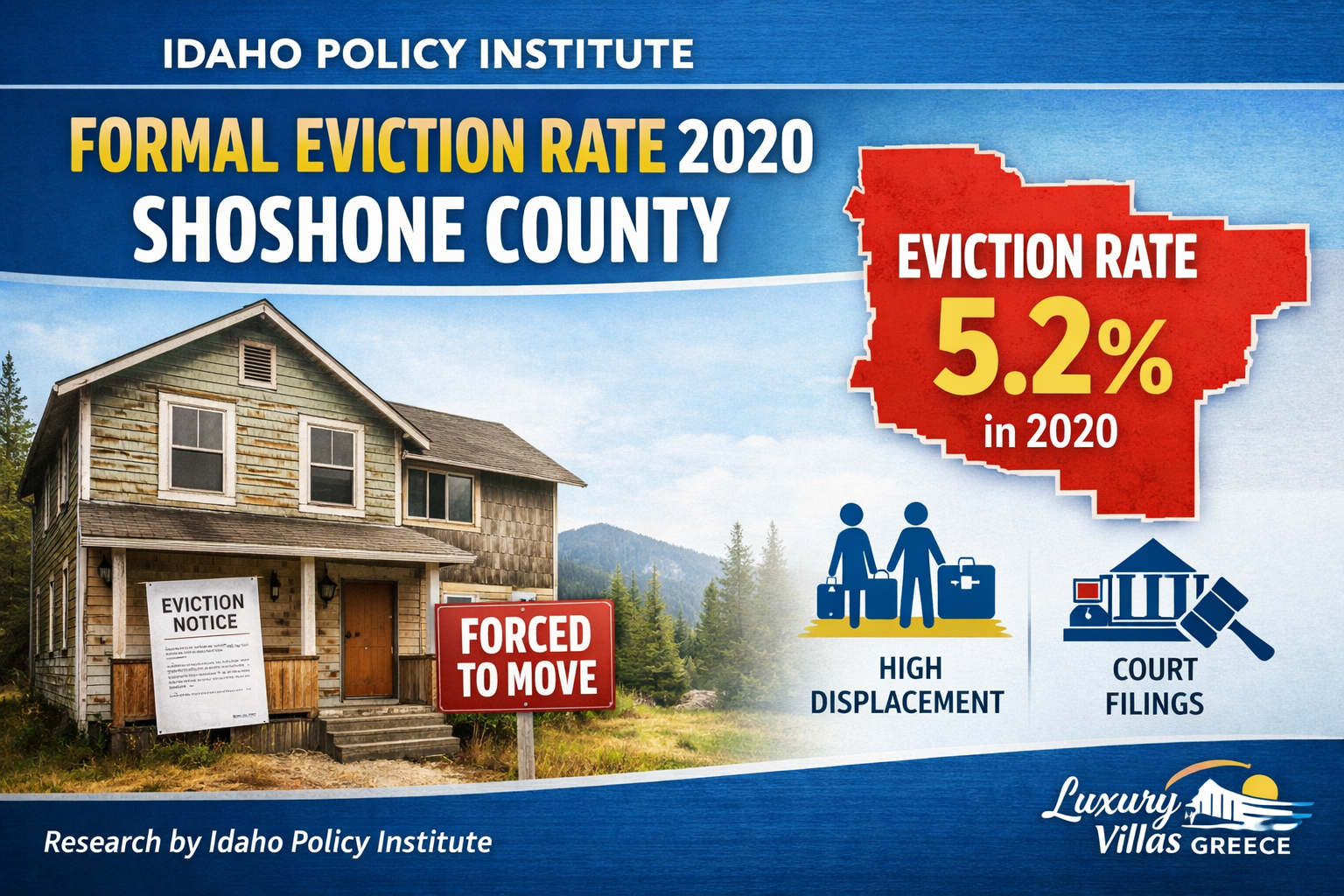
When researchers at Boise State University’s Idaho Policy Institute (IPI) started pulling together county-level eviction data for 2020, Shoshone County showed up as one of the state’s smaller but telling data points. The formal eviction rate for Shoshone County in 2020, as documented through IPI’s housing research, came in at approximately 0.6% of renter households, a figure that reflects both the county’s small renter population and the suppression effect of pandemic-era federal eviction moratoriums.
Shoshone County sits in northern Idaho’s Silver Valley, historically a mining region that now operates with a modest and aging housing market. With a relatively small number of renter-occupied households compared to Ada or Canyon counties, even a handful of formal eviction filings can shift the rate noticeably from year to year.
~0.6%Estimated formal eviction rate, Shoshone County, 2020
44Approximate total renter households counted in analysis period
2020Year covered under IPI housing research & eviction tracking
Table of Contents
Why 2020 Was an Unusual Year for Eviction Data
Any discussion of the 2020 formal eviction rate for Shoshone County, or any Idaho county for that matter, has to account for one major factor: the CDC’s national eviction moratorium. Signed in September 2020 and building on earlier CARES Act protections, the moratorium blocked a significant portion of eviction filings that would otherwise have entered court records.
This means the formal eviction numbers IPI tracked in 2020 are widely understood by housing researchers to be lower than what underlying financial stress and nonpayment issues actually were. Formal filings require a landlord to initiate a court process. When that process is legally restricted, the numbers drop, but the housing instability behind them does not.
Context: What “Formal Eviction Rate” MeansThe formal eviction rate measures the share of renter households that faced an official eviction filing in court during a given year. It does not count informal removals, verbal agreements to vacate, or cases where tenants left before a filing occurred. Researchers consider the formal rate a floor, not a ceiling, of actual housing displacement.
Shoshone County in the Broader Idaho Picture
Compared to Idaho’s most active eviction markets, Shoshone County is a small-volume jurisdiction. The Idaho Policy Institute’s county-level work draws on court filing records, U.S. Census Bureau rental household estimates, and American Community Survey data to calculate annual rates. In rural counties like Shoshone, low renter population numbers mean the data carries higher margin-of-error weight per filing.
What makes IPI’s research valuable for a county like Shoshone is the longitudinal view. Year-over-year comparisons, not single-year snapshots, tell the cleaner story about housing stability. The 2020 figures serve best as a baseline for watching what happened after moratorium protections expired through 2021 and into 2022, when filing activity tended to surge in counties with pent-up cases.
“Formal eviction rates in rural Idaho counties reflect court activity, not the full scope of housing precarity families actually experience.”
Key Findings
What the Idaho Policy Institute Data Tracks
IPI’s eviction-related research covers several dimensions that go beyond a single rate figure:
- Filing volume per county: Raw number of formal eviction cases initiated in county courts.
- Rate per renter households: Filing volume divided by estimated renter-occupied housing units, using Census Bureau ACS five-year estimates.
- Geographic comparison: How rural counties like Shoshone compare to urban centers and state averages.
- Year-over-year trends: Changes across pre-pandemic, pandemic, and post-moratorium periods to identify real shifts versus policy-suppressed dips.
- Demographic overlap: Where available, cross-referencing eviction data with income, age, and population data to understand who is most affected.
What This Means for Renters in Shoshone County
For residents of Wallace, Kellogg, or Osburn looking at these figures, the 2020 formal eviction rate landing around 0.6% carried real meaning. It was lower than many comparable rural counties nationally, partly because of moratorium protections and partly because Shoshone County’s rental market is small and relatively low-turnover.
At the same time, researchers and housing advocates have noted that rural Idaho renters faced significant affordability pressure through 2020 and after. Statewide rent increases accelerated between 2020 and 2022, and smaller counties with limited housing stock were not immune. The formal eviction number being low did not mean the financial pressure on renters was low.
Where to Find the Idaho Policy Institute’s County Eviction Data
IPI, housed within Boise State University, publishes its Idaho-specific housing and policy research through the university’s website and through reports available to the public. For researchers, journalists, or policymakers looking at Shoshone County eviction figures specifically, IPI’s work remains one of the few sources that tracks Idaho counties at this level of geographic specificity rather than relying solely on national databases like Princeton University’s Eviction Lab, which has thinner data for smaller Idaho counties.
The Idaho Policy Institute’s formal eviction rate research for 2020 in Shoshone County underscores a recurring reality in rural housing policy: small counties generate small numbers, and small numbers carry big stakes for the families those numbers represent.