
 By Oscar Woods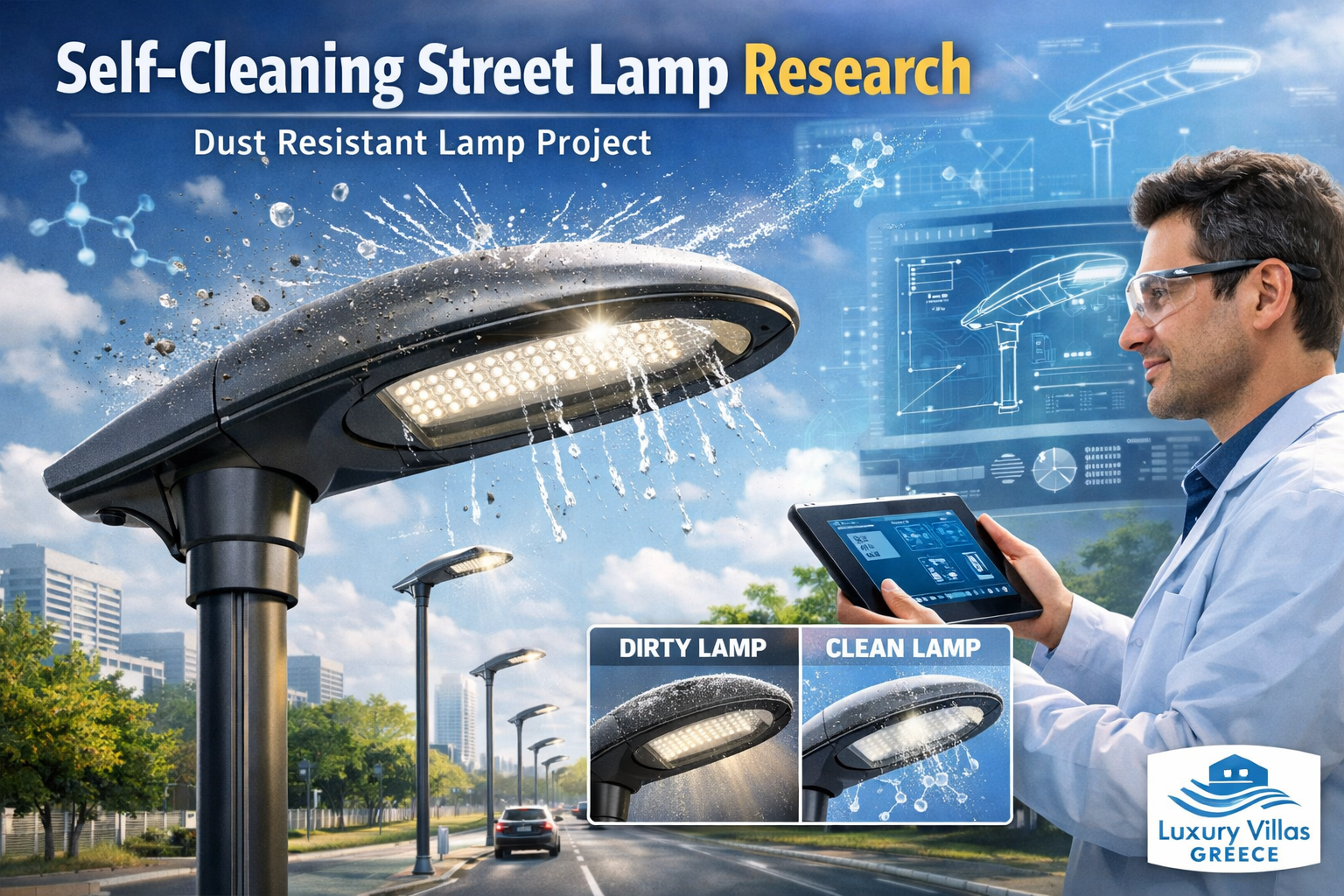
Dirty street lamps are costing cities money. And in dusty, arid, or pollution-heavy regions, the problem is worse than most people realize.
Dust buildup on street lamp solar panels can slash energy output by 20 to 50 percent, according to research published in PMC (National Library of Medicine). That means dimmer roads, shorter lighting hours, and maintenance crews dispatched more often. In some environments, like oil palm plantations in West Africa, contamination from dust and airborne oil mist can push annual cleaning costs beyond $300 per unit.
So the question researchers and engineers have been asking: can a lamp clean itself?
As it turns out, yes. And self-cleaning street lamp research is further along than most people expect.
Table of Contents
The Problem That Sparked the Research
Street lamps across the Middle East, sub-Saharan Africa, and Southeast Asia face conditions that standard fixtures simply were not built for. Sand haboobs, agricultural dust, industrial mist, and high humidity combine to coat lamp surfaces and solar panels within days of installation.
Traditional solutions are labor-intensive. Manual scrubbing requires crews, water resources, and repeated scheduling. In remote or elevated locations, this becomes a logistical and financial problem fast.
A 2020 peer-reviewed study published in Discover Applied Sciences (Springer Nature) introduced FACS, a fully automatic cleaning system for street lighting, controlled by a microcontroller with passive infrared and dust/rain sensors. The research compared it against all available cleaning technologies and concluded that automated systems deliver strong performance in shorter time frames at lower cost.
That study was a foundation. Since then, research and real-world deployment have both moved quickly.
What the Technology Actually Looks Like
Self-cleaning lamp systems today fall into a few distinct categories:
Nano-hydrophobic coatings These are applied directly to solar panel surfaces and lamp covers. A 2022 study in Scientific Reports (Nature Portfolio) found that a PDMS/SiO2 nanocoating reduced dust density on panels from 10 g/m² to 4.39 g/m² after 40 days of outdoor exposure, marking a 30.7% efficiency improvement over uncoated panels. A separate ScienceDirect review covering four decades of PV dust research (1983 to 2024) confirmed that super-hydrophobic coatings can reduce dust accumulation by up to 50 percent.
One trade-off worth noting: hydrophobic coatings tend to degrade under UV exposure after 3 to 4 years. Hydrophilic coatings, by contrast, can sustain performance for up to 25 years in some conditions, per research published in Scientific Reports in 2024.
Robotic brush systems Motor-driven arms or rollers sweep across solar panel surfaces on a timer or when sensors detect reduced light output. They typically run for 30 to 60 seconds at a time, consume less than 2% of daily generated energy, and require no water.
Electrostatic dust removal This waterless method applies a high-voltage charge (around 12 kV) to create a repulsive force that ejects dust particles off the surface. Lab results have shown up to 95% power recovery for particles larger than 30 microns. It requires ambient humidity above 30% and struggles with very fine particles below that threshold.
Projects Already Running in the Field
This is not research sitting in a lab. Multiple companies have put dust-resistant lamp technology into active use.
BOSUN Lighting deployed a self-cleaning solar street light system in Port Harcourt, Nigeria, across 9 km of oil palm plantation roads. The system uses nano-hydrophobic coatings combined with robotic cleaning arms that sweep panels twice daily. It runs off-grid with LiFePO4 batteries carrying an 8 to 12-year lifespan. Dirty panels in that environment previously caused 30 to 40% energy loss within months.
Gletscher Energy’s Stellar Series has been deployed across Saudi Arabia and the UAE, covering desert highways, airport zones, and urban parks. These units carry IP65/IP66 dust-tight ratings, marine-grade aluminum alloy housing, and tilt-adjustable solar brackets at 15 to 35 degrees that help loose sand slide off naturally. A robotic brush system handles active cleaning.
JSD Solar’s Alpha Series integrates an IoT LoRa control system with automated daily panel cleaning, remote fault monitoring via 4G/3G connectivity, and a LiFePO4 battery rated for over 2,000 charge cycles across temperatures from -25°C to 65°C.
In Nigeria’s Cross River State, a 2022 community program brought self-cleaning street lights to 65 rural communities, using IP68-rated enclosures and automated electrostatic cleaning suited for harmattan dust conditions.
What Research Says Still Needs Work
Progress is real, but researchers are candid about the gaps.
The 2024 ScienceDirect review of four decades of dust mitigation research identified that monitoring systems integration remains complex, and that most current cleaning schedules are fixed-interval rather than adaptive. Shifting to AI-driven decisions based on real-time weather and sensor data could reduce the levelized cost of energy by 8% for large-scale systems, according to that review.
Other open challenges researchers have flagged:
- Fine particles under 30 microns require hybrid approaches, as neither electrostatic nor mechanical methods alone handle them reliably
- Electrostatic systems underperform in low humidity, which limits their use in dry desert climates
- High upfront costs for nano-coatings and IoT infrastructure remain a barrier in lower-income regions
- Long-term mechanical wear on brush systems, despite marketed 10-year lifespans now becoming standard
Where the Research Points Next
Work on IoT-based self-cleaning smart city street lighting documents designs that integrate real-time monitoring, green-principle engineering, and controllers that manage both solar charging and automated cleaning cycles within one system.
The direction is toward lamps that track their own performance, schedule cleaning from forecast data, report faults remotely, and adjust brightness based on live traffic data. Some systems already do parts of this. The complete integration is close.
Self-cleaning street lamp research and dust-resistant lamp projects have cleared the proof-of-concept stage. The science is documented, the hardware is deployed, and results from Port Harcourt to the Arabian Peninsula show these systems hold up in some of the toughest conditions on the planet.